Trends
Restaurant Data Intelligence Platform
Custom Apps
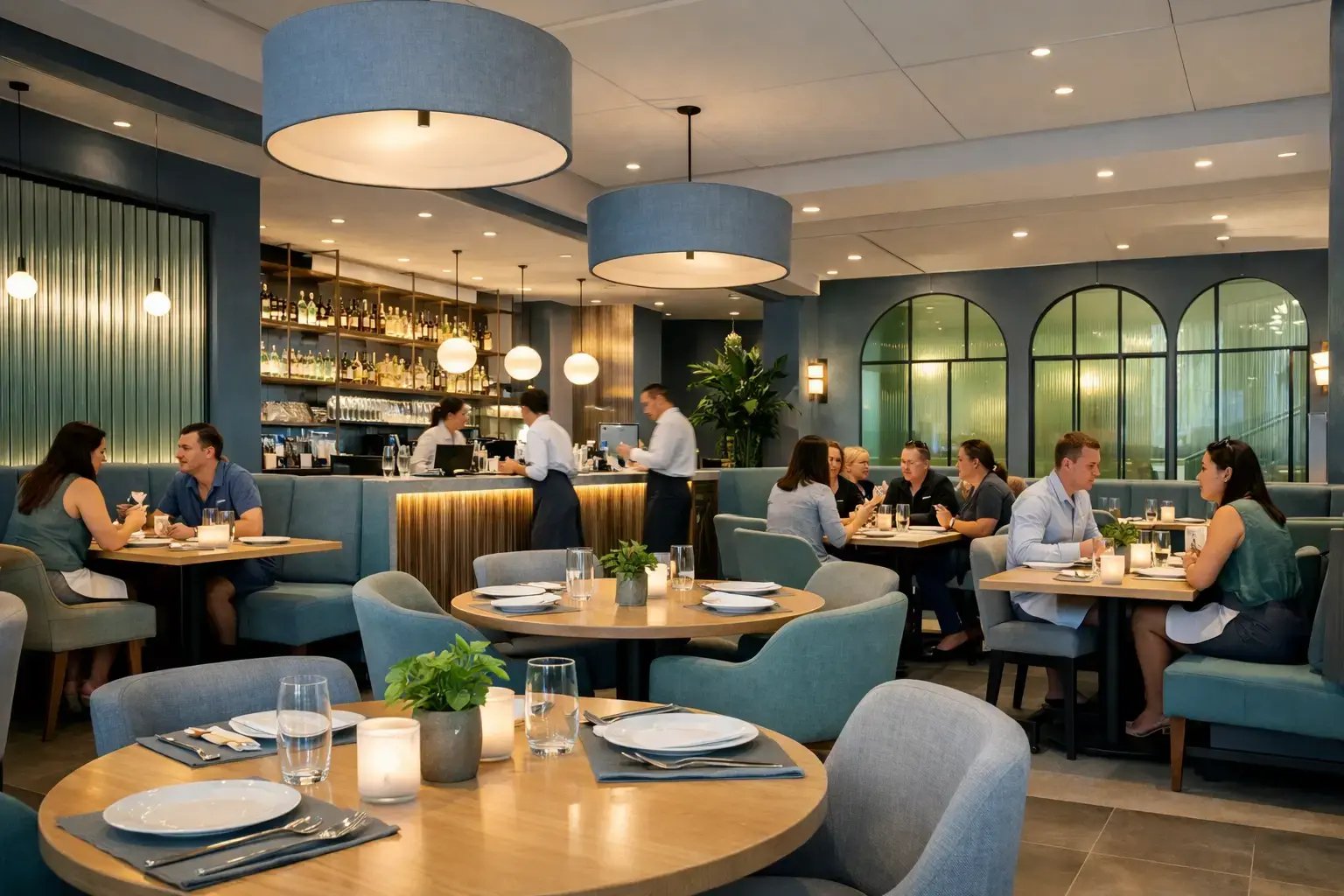

The debate is over. The question now is how fast operators can move from curiosity to competitive advantage. This POV was validated last week, after an amazing MURTEC 2026 conference where industry thought leaders confirmed what a lot of us already knew... "AI" is "IT."
The restaurant industry has never been great at sitting still, and in 2026 that restlessness is driving a wave of AI adoption that is reshaping how operators think, plan, and run their businesses. AI has transitioned from an experimental novelty to an operational necessity, with persistent labor shortages and tightening margins doing most of the convincing. For operators who have been watching from the sidelines, the window for easy differentiation is closing.
Qu's 7th Annual Restaurant Technology Benchmark Report, released just days ago, found that brands are increasing technology investment and accelerating AI adoption to combat economic headwinds and declining guest traffic. The posture has shifted. This is no longer a conversation about pilots and proof-of-concept. It is a conversation about execution and scale.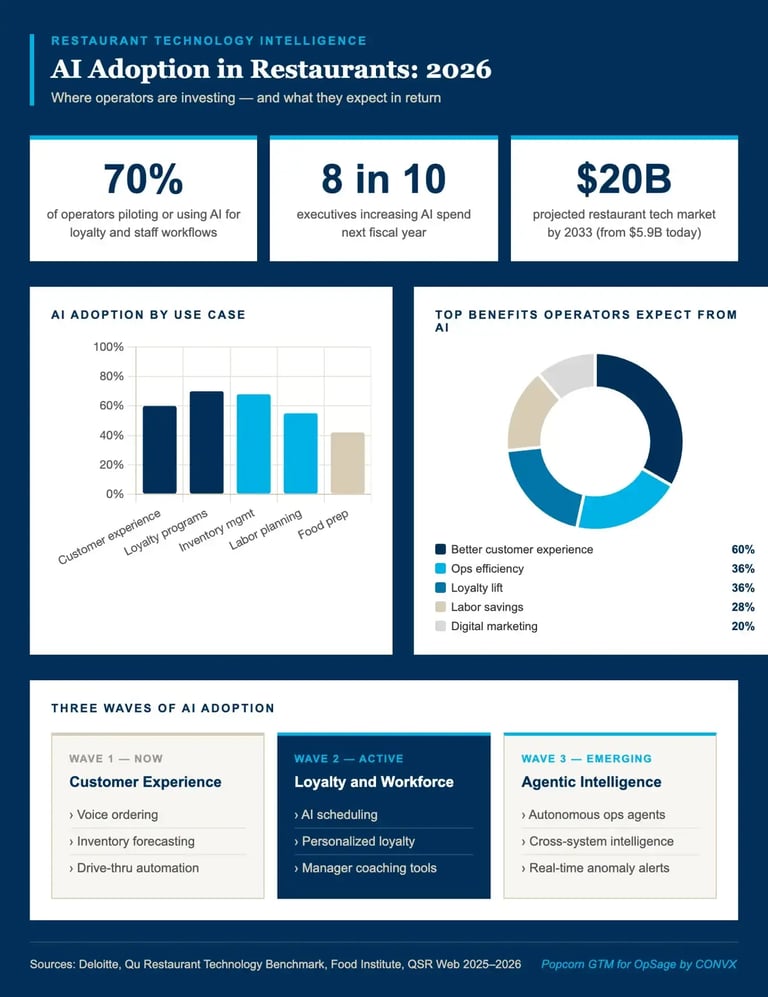
The most public-facing AI deployments have been at the drive-thru, and the scale is notable. Yum! Brands has processed more than 2 million drive-thru orders through its AI voice ordering system across more than 300 Taco Bell locations, and is expanding the technology as part of a broader collaboration with Nvidia to integrate AI tools across restaurant operations. Chipotle is going deeper inside the kitchen, testing a system developed with PreciTaste that uses AI and machine learning to forecast demand and manage ingredient preparation in real time.
The second wave of AI adoption is focused on boosting customer loyalty and enhancing the employee experience, with implementation hovering near 70% for both areas. This is where AI starts living inside operations rather than just touching them at the edges. Yum Brands deployed its Byte AI Restaurant Coach across more than 28,000 restaurants to help store managers make faster decisions on staffing, scheduling, and performance. These are systems that quietly work in the background so operators can focus on hospitality instead of spreadsheets.
In 2026, generative AI is being eclipsed by AI agents: systems that can take action on their own, without waiting to be asked. These agents do not just answer questions. They monitor, analyze, recommend, execute, and learn. Think of them as digital operators who never sleep, never forget, and get smarter over time. Building software intelligence on top of existing systems of record, including POS, supply chain, and labor tools, is now realistic for operators of all sizes.
"Without a unified data foundation, AI becomes another tool layered onto disconnected systems rather than a true growth engine." — Amir Hudda, CEO, Qu
Here is the uncomfortable truth sitting underneath all the momentum: most operators are generating more data than ever and getting almost none of the strategic value out of it. POS systems, labor platforms, inventory tools, loyalty programs, delivery integrations. They all exist. They just do not talk to each other in any meaningful way.
The result is a patchwork of reports, a lot of gut-feel decisions, and very little operational clarity. Technology vendors are actively developing AI solutions to bridge the gap between the largest resource-rich restaurant chains and everyone else, but for most growth-stage and mid-market operators, that gap has felt impossible to close without a team of data engineers on staff.
That is finally changing.
OpSage by CONVX is one of the more compelling answers to the question every multi-unit operator is quietly asking: how do we get real intelligence out of the systems we already run without a 12-month implementation project?
OpSage unites all your restaurant data into one AI-powered platform, transforming disconnected systems into operational clarity through its proprietary OpSage AI Assistant. The key phrase is "existing systems." OpSage is not asking operators to rip and replace. It is built to be the intelligence layer that sits on top of what is already running in the restaurant, connecting POS, labor, accounting, inventory, marketing, loyalty, and more into a single, coherent picture.

The conversational interface is what sets this apart from traditional reporting tools. Store managers and corporate teams can ask plain-language questions and get answers they can act on immediately. A few examples:
This is not another dashboard that requires a data analyst to decode. OpSage is your always-on restaurant intelligence assistant that listens, learns, and translates data into clear, actionable insight. Whether you are pricing a new menu item, refining prep levels, or adjusting labor on the fly, OpSage helps every decision feel less like a guess.
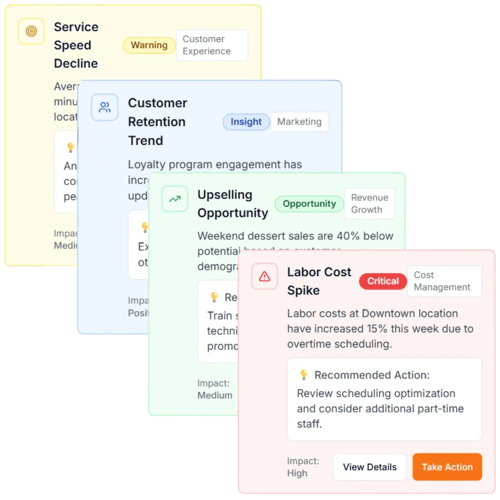 The anomaly detection capability is worth calling out separately. OpSage continuously watches your data and flags when something breaks pattern, so you can fix issues while they are still small. Think of it as a smoke detector for operations, not just a rearview mirror. Real-time alerts by email or SMS mean the right person sees the signal at the right moment, not at the end of the month when the damage is already done.
The integration library is deep and growing, connecting with Toast, Olo, Punchh, SynergySuite, Medallia, Ovation, PAR, and others. Every role in the organization, from the C-suite to the franchisee operator, can access the data that matters to their decisions, with permissions configured to match the responsibility.
The restaurant tech conversation has too often been dominated by what the Taco Bells and Chipotles of the world are building. But the most significant AI growth in 2026 is happening in quiet, unsexy back-of-house systems that improve margins, flag problems early, and help operators make smarter decisions at every level of the organization.
The brands that get their data unified now and get an intelligent assistant working across their operation will have a meaningful head start. The era of running a multi-unit operation on a patchwork of disconnected reports and gut instinct is ending. Tools like OpSage are making the next era accessible, not just for enterprise chains, but for the 30-unit regional group, the growing fast casual, and the franchise operator trying to scale with less chaos and more clarity.
The operators who move first will not just be more efficient. They will be harder to compete with.
See how OpSage by CONVX connects your existing restaurant systems and puts real-time intelligence in the hands of every decision-maker in your operation, from the store floor to the C-suite.
Request a Demo →