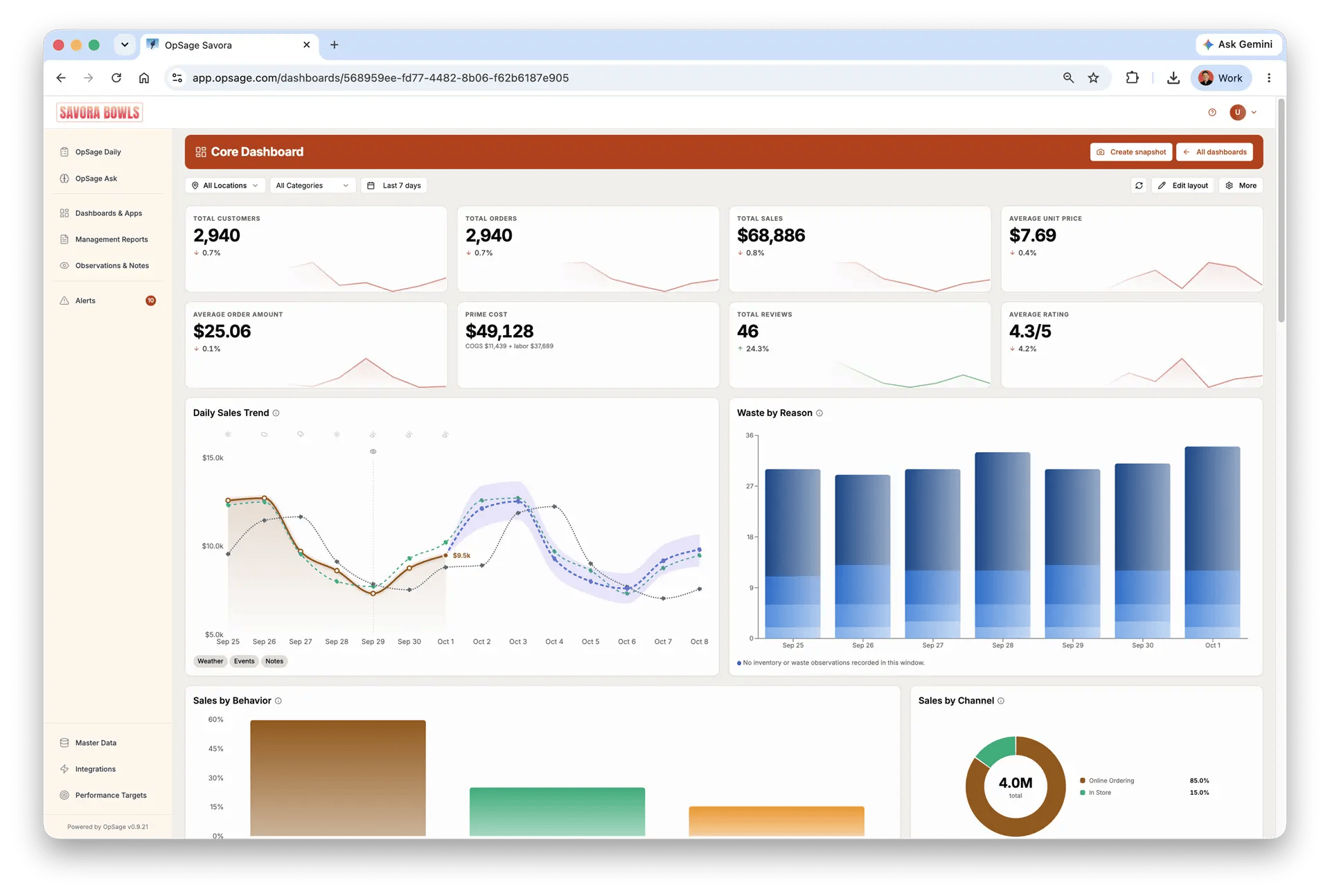
For multi-unit restaurant operators, the weekly manager’s report has always been a tax on time. Not because the data doesn’t exist — it does, scattered across POS systems, labor platforms, and review sites — but because someone still has to collect it, normalize it, and wrestle it into a spreadsheet that may or may not look anything like last week’s.
OpSage Release 0.9.4 eliminates that tax.
The centerpiece of this release is Business Reports: a fully automated, AI-analyzed weekly report built from the cross-domain data OpSage already holds. Sales, labor, reviews, and cost metrics in a single structured view — populated automatically, delivered on schedule, and explained in plain language. No spreadsheets required.
What’s New in Release 0.9.4
Business Reports: Auto-Populated Weekly Reports
OpSage now includes a dedicated Reports section that delivers structured weekly reports without anyone having to build them. Sales, labor, review, and cost metrics are pulled directly from the systems already connected to your OpSage account and organized into a consistent, comparable format.
Editable targets let you set performance benchmarks at the location or portfolio level, with immediate variance recalculation whenever targets change. For locations where automated data isn’t yet available for a specific field, manual entry keeps the report complete without breaking the workflow.
What makes this different from the reports already built into your POS or labor platform: those tools report on a single domain. OpSage combines sales, labor, reviews, and cost in one place — which means the variance you’re looking at is the full picture, not a slice of it.
Learn more about how OpSage unifies your operational data on the OpSage Platform page.
AI Analysis on Every Report
Numbers tell you what happened. AI analysis tells you what to pay attention to.
Click “Generate analysis” on any Business Report and OpSage produces plain-language highlights and concerns drawn from the full cross-domain context it already has. Where did labor run high relative to sales? Did a spike in negative reviews correlate with a specific shift or daypart? What’s worth a conversation with your regional manager?
This analysis is included in exported PDFs, which means it travels with the report — every stakeholder who receives the document gets the interpretation alongside the data, not just the scorecard.
It’s also the capability that most directly separates OpSage from every single-source reporting tool in the market. Competitors show the numbers. OpSage explains them.
See how OpSage’s AI Assistant works across your entire operation on the OpSage AI Assistant page.
PDF, CSV, and Scheduled Email Delivery
Reports that stay inside a platform don’t reach the people who need them. OpSage 0.9.4 adds PDF and Excel-ready CSV export alongside scheduled email delivery — so the weekly report lands in the right inboxes every Monday morning without a person having to send it.
No per-user license fees. Reports, scheduled delivery, and external recipients are all included in the OpSage subscription. For a 100-location operator who wants store managers, regionals, and finance stakeholders all on the distribution list, that’s a material difference from BI tools and most restaurant platforms that charge per seat. With OpSage, distribution is a setup task, not a budget line.
Dashboard Reliability Improvements
This release also includes five bug fixes — three classified as High-priority — across AI Chat, dashboard metrics, and comparison charts. The most significant: AI Chat no longer carries stale data from a previous query into a new one.
This fix closes a confidence gap. When AI Chat said “no data available” while the visual widgets still showed the old data, users had reason to second-guess the AI’s accuracy. That gap is now closed. Trust in the numbers is the foundation for trust in the AI.
Why This Release Matters
The Weekly Report Has Been the Industry’s Biggest Unsolved Productivity Problem
One to two hours per location per week, every week, at every multi-unit operator. That’s the real cost of the manual weekly report, and it compounds at scale. A 50-location operator is burning hundreds of hours a month on data collection and formatting that adds no analytical value.
Automating the report is only part of the answer. The other part is making reports comparable across locations. When every manager builds their own spreadsheet, performance management becomes a negotiation over whose numbers are right rather than a conversation about what to do. Business Reports solves both problems simultaneously: the data is populated automatically, and the format is consistent across every location in the portfolio.
The Cross-Domain Advantage Is the Headline
Every POS, labor platform, and review aggregator already offers some version of reporting. The gap is cross-domain visibility — and that’s where OpSage’s architecture makes the difference.
When sales are up but labor costs are also up and reviews are trending negative, the story isn’t in any single system. It’s in the relationship between them. OpSage’s Business Reports surface that relationship automatically — and the AI analysis layer explains it in language that drives action.
Understand the full scope of OpSage’s capabilities on the Capabilities page.
The Licensing Model Is a Competitive Wedge
Per-seat pricing turns report distribution into a budget conversation. Every new stakeholder you want to add to a distribution list means a license negotiation. BI tools and most restaurant platforms are built on this model — which means broad access to operational reporting is effectively gated by budget.
OpSage inverts that dynamic. Reports, scheduled delivery, and external recipients are included in the subscription. The default is everyone gets access — and adoption inside the customer compounds as a result. Reports that reach more people get used more. That’s a direct driver of retention and expansion.
What Comes Next...
Release 0.9.4 establishes the data model that supports the full Business Reports roadmap. Phase 2 brings AI narrative generation per report section, multi-location comparison views, and a template builder. Phase 3 adds predictive reports, a custom report builder, and industry-standard templates aligned to common operational benchmarks.
Operators adopting Business Reports today aren’t adopting a one-off feature. They’re adopting a framework that grows with the platform.
Want to see Business Reports in action? Request a demo and we’ll walk you through the full weekly report workflow — from auto-populated data to scheduled delivery.

.jpg?width=1400&height=787&name=OpSage%20Daily%20(1).jpg)

.png?width=48&height=48&name=Conrad%20Face%201%20(1).png)