OpSage is a platform in active development, shaped by the realities of running restaurants at scale.
We publish technical release notes to capture new features, architectural improvements, bug fixes, and security updates. Click here to see the latest Release Notes.
OpSage is a fully managed AI intelligence platform built specifically for multi-unit restaurant operators. It aggregates data from all of your core systems including, POS, labor, inventory, loyalty, reviews, and weather into a unified model, then applies AI and machine learning across every data domain simultaneously to deliver actionable intelligence to every role in your organization.
The result is a platform that can answer the cross-functional questions no single system can answer on its own: Why did food cost spike at three locations last week? Is our understaffing problem driving declining review scores? Which locations should adjust prep and staffing for next weekend's weather?
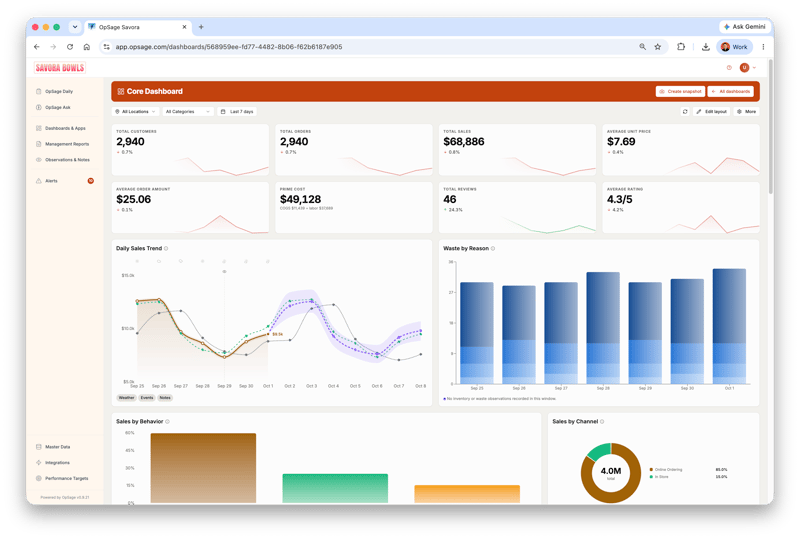
OpSage is purpose-built for multi-unit restaurant operators - typically brands managing between 30 and 3,000 locations. The platform is designed to serve every layer of the organization:
Each user sees only the data relevant to their role and scope. The platform scales from a single region to the full portfolio without additional configuration.
Traditional BI and dashboard tools require a data team to build and maintain the reports. Someone has to define the metrics, write the queries, design the dashboards, and keep everything updated as your business changes. OpSage eliminates that bottleneck entirely.
Instead of building dashboards and waiting for answers, any authorized user can ask a question in plain English and receive a data-backed answer (with supporting charts and context) in seconds. The platform also proactively surfaces insights through daily reports and anomaly alerts, so you don't have to go looking for problems.
More fundamentally, BI tools work with one data source at a time. OpSage™ combines sales, labor, inventory, reviews, weather, and forecasting into a single intelligence layer, enabling cross-functional analysis that no dashboard tool can replicate.
General-purpose AI tools like ChatGPT have no access to your operational data. They can answer general questions about the restaurant industry, but they cannot tell you why Store #14 had a bad Tuesday or whether your downtown location's food cost is trending in the wrong direction.
OpSage is grounded in your actual data, including your sales history, your labor records, your customer reviews, your inventory. It also understands your specific business: your concept type, price tier, organizational structure, and strategic priorities. That context shapes every answer the AI produces. And unlike general-purpose tools, OpSage enforces enterprise-grade role-based access controls so the right people see the right data.
It means CONVX handles all the infrastructure, the data warehouse, the integration pipelines, the AI and machine learning models, the security architecture, and ongoing maintenance. Your team does not need a data engineer, a data scientist, or a dedicated analytics analyst to run OpSage.
Building this kind of capability in-house typically costs millions of dollars upfront and hundreds of thousands annually to maintain, and requires specialized talent that is difficult to hire and retain. OpSage delivers the same capability as a managed platform, on a software subscription.
You can ask OpSage virtually any question about your restaurant operations in plain English. The platform handles both focused, single-domain questions and complex cross-functional ones. Some examples:
Every response includes supporting data, and the AI can generate charts, run statistical analysis, and decompose root causes, not just return a number.
Every morning, OpSage delivers a written AI report to each user's inbox, no action required. The report includes an AI-generated narrative summary of the prior day's performance (what went well, what didn't, and why), a sales recap against baseline and prior year, week-to-date performance with projections, a prime cost snapshot, a summary of customer reviews organized by sentiment theme, and any anomalies detected in the last 24 hours.
Reports are tailored to each user's role and location scope. A regional manager receives a regional view; a store manager sees their location. The narrative also reflects your stated business priorities, if cost reduction is your primary focus, the report leads with food and labor cost trends. Users can opt in or out of email delivery at any time.
OpSage's machine learning model continuously monitors all connected data streams. It establishes a historical baseline for each metric at each location, accounting for day-of-week patterns, seasonality, weather norms, and holidays. When actual performance deviates significantly from the expected range, an anomaly is flagged.
Alert thresholds are calibrated to your specific concept type and price tier, not generic industry benchmarks. This dramatically reduces false positives and ensures every alert is actionable for your business. Alerts are delivered via email, SMS, or both based on user preferences. When an alert arrives, users can open AI Chat immediately to diagnose the root cause.
Every incoming review is processed through OpSage's AI pipeline, which assigns a quantified sentiment score, extracts recurring themes (food quality, service speed, drive-thru experience, cleanliness, staff friendliness), and tracks specific observations within each theme over time.
What makes this different from standalone review platforms is the connection to your operational data. When "slow service" complaints spike at a location, OpSage™ can automatically check whether that location was understaffed, whether sales volume was unusually high, or whether a specific day part is driving the complaints. This transforms review monitoring from a passive read into an active diagnostic.
Cross-domain intelligence is OpSage's ability to answer questions that span multiple data sources simultaneously. The highest-value questions in restaurant operations are almost always cross-functional: prime cost requires sales, labor, and inventory data. Root cause analysis of a sales decline requires weather, staffing, and reviews. Menu engineering requires sales, food cost, and customer feedback.
No single-source tool can answer these questions because the answer lives in the intersection of multiple systems that were never designed to talk to each other. OpSage™ unifies all of those data domains into a single intelligence layer so the AI can reason across all of them at once.
OpSage's machine learning forecasts are generated at the location, day, and day-part level. Inputs include location-specific historical sales patterns, seasonality, weather (historical and forward-looking forecasts for the US and Canada), a tenant-specific holiday calendar, and local events data. Forecast outputs include confidence intervals and variance tracking (actual vs. forecast) that continuously feeds back into the model to improve accuracy over time. Forecasts are also translated into ingredient-level demand projections based on your menu mix, making them directly actionable for inventory prep.
OpSage connects to the core operational systems that drive your business: POS systems (including Toast, with structured integration across orders, menu, labor, and dining options data), workforce management and labor scheduling systems, inventory management platforms such as Marketman and CrunchTime, review platforms (Google, Yelp, TripAdvisor), and weather data services. CONVX builds and manages all integration connectors, your team does not need to configure or maintain them. Contact us if you have questions about a specific system in your tech stack.
OpSage™ is built on enterprise-grade infrastructure. The data warehouse is Snowflake, using a multi-tenant secure architecture with logical data isolation between tenants. Authentication is managed through AWS Cognito. Role-based access control is enforced at the data layer — not as a post-hoc filter, ensuring unauthorized data is never exposed through the AI interface.
The AI reasoning layer uses a LangGraph agent pipeline that assembles full business context before every query. The semantic layer is a purpose-built YAML-based model that defines your business concepts, dimensional relationships, and KPI calculations with tenant-specific precision, ensuring consistency and accuracy across every AI interaction.
OpSage™ uses AI to automate data mapping as your business changes. When a new menu item, employee, job title, or inventory ingredient flows into the platform, the AI automatically infers how it should be categorized within your reporting structure, without manual intervention. Users retain full visibility and override capability through a drag-and-drop interface, and the model learns from any corrections made.
If your current tools are answering your most important operational questions, across all your data domains, for every role in the organization, without requiring an analyst to pull reports, then you may not need OpSage.
If critical questions fall through the cracks between systems, if managers spend too much time gathering data instead of acting on it, or if your existing tools can tell you what happened but not why, then OpSage™ is designed to fill exactly that gap. It doesn't replace your POS or labor system. It sits above all of them and connects them into a unified intelligence layer.
OpSage is designed for multi-unit restaurant operators, typically in the range of 30 to 3,000 locations. This is the segment where the complexity of managing cross-location performance is high enough to warrant an AI intelligence layer, but where the resources to build that infrastructure in-house are typically out of reach. If you're below 30 locations or significantly larger, contact us to discuss fit.
No. OpSage™ is specifically designed for operator organizations that do not have, and do not want to build, an in-house data team. CONVX manages all integration development, data mapping, platform configuration, and ongoing maintenance. On the client side, you'll need an internal point of contact to help configure your organizational structure, business priorities, and user access. Beyond that, the platform is designed to be used directly by operations leaders and managers — no technical expertise required.
OpSage works across segment types, QSR, fast casual, casual dining, and polished casual. The platform's business-aware AI calibrates benchmarks, anomaly thresholds, and recommendations to your specific concept, cuisine, and price tier. A 32% food cost reads differently for a QSR burger chain than for a fine dining steakhouse, and OpSage™ knows the difference. When you connect to the platform, OpSage™ automatically researches your brand, builds a structured business profile, and uses that profile as the foundation for every AI interaction.
OpSage uses role-based access control (RBAC) enforced at the data layer, not as a filter applied after the fact. Before any query is generated, the platform scopes the context to only the locations the user is authorized to see. A restaurant manager's AI Chat queries only return data for their location. A regional manager sees their assigned region. There is no path through the AI interface to access data outside a user's authorized scope. The platform supports five defined roles: Account Owner, Data Owner, Business Viewer, Regional Manager, and Restaurant Manager.
Yes. OpSage is built on Snowflake's multi-tenant secure data architecture with logical data isolation between tenants. Your data is never commingled with another operator's data. For organizations that require physical data separation, a dedicated tenant database option is also available.
OpSage is designed for fast onboarding with minimal effort on your side. The process moves through seven stages: adding your locations (OpSage™ integrates with Google Maps, so details populate automatically, no spreadsheets), connecting data sources (CONVX builds and manages all integration connectors), AI-generated business profiling (OpSage™ automatically researches your brand, discovers competitors, and recommends performance targets), organizational configuration (regions, hierarchies, day parts, holiday calendar, business priorities), and then the AI begins working automatically once data flows. From there, AI Chat is available immediately with intelligent prompt suggestions, and daily report delivery begins per each user's role and preferences.
Implementation timelines vary depending on the number of data sources being connected and the complexity of your organizational structure. CONVX works directly with your team and your technology vendors to build and validate each integration. Once data begins flowing, the AI capabilities activate automatically. Contact us for a specific timeline estimate based on your tech stack and portfolio size.
Visit opsage.com/contact to request a demo. A member of the OpSage team will reach out to schedule a walkthrough tailored to your concept, portfolio size, and the specific operational questions you're trying to answer. Demos are live, not scripted.
Still have questions? See OpSage™ in action.
Request a Demo →