---
title: After the NRA Show, the Real AI Question for Restaurants Is Just Getting Started
description: "OpSage CEO, Eric Lehto, is featured in the \"Modern Solutions for Modern Restaurants\" podcast. Explore the challenges and insights of AI in the restaurant industry, focusing on data intelligence, security, and effective implementation strategies for operators."
image: https://opsage.com/hubfs/ai-next.jpg
---
[Skip to content](https://opsage.com/convx-blog/after-the-nra-show-the-real-ai-question-for-restaurants-is-just-getting-started#main-content)
[Homepage](https://opsage.com)
- [Platform](https://opsage.com/restaurant-data-platform)
- [OpSage™](https://opsage.com/opsage-ai-assistant)
- Resources
- [FAQ](https://opsage.com/faq)
- [Release Notes](https://opsage.com/release-notes)
- [News & Blog](https://opsage.com/convx-blog)
- [Video Overview](https://opsage.com/opsage-operational-ai-overview)
- [Pricing](https://opsage.com/pricing)
[Contact Us](https://opsage.com/contact)
- [Platform](https://opsage.com/restaurant-data-platform)
- [OpSage™](https://opsage.com/opsage-ai-assistant)
- Resources
- [FAQ](https://opsage.com/faq)
- [Release Notes](https://opsage.com/release-notes)
- [News & Blog](https://opsage.com/convx-blog)
- [Video Overview](https://opsage.com/opsage-operational-ai-overview)
- [Pricing](https://opsage.com/pricing)
[Contact Us](https://opsage.com/contact)
Trends Restaurant Data Intelligence Platform
# After the NRA Show, the Real AI Question for Restaurants Is Just Getting Started
.png?width=48&height=48&name=Conrad%20Face%201%20(1).png)
Convx Team
June 1, 2026
If you walked the floor at the National Restaurant Association Show in Chicago in May, you already know: AI was everywhere. On booth banners. In product demos. In nearly every conversation between operators and vendors. The word showed up so frequently it started to lose meaning.
That is precisely the problem.
With AI dominating the conversation at one of the industry's biggest annual gatherings, the question restaurant operators are now wrestling with is not whether to adopt AI. It is how to tell the difference between AI that is real and AI that is a label on a legacy product. And more importantly, how to build the foundation that makes AI actually work in a restaurant operation.
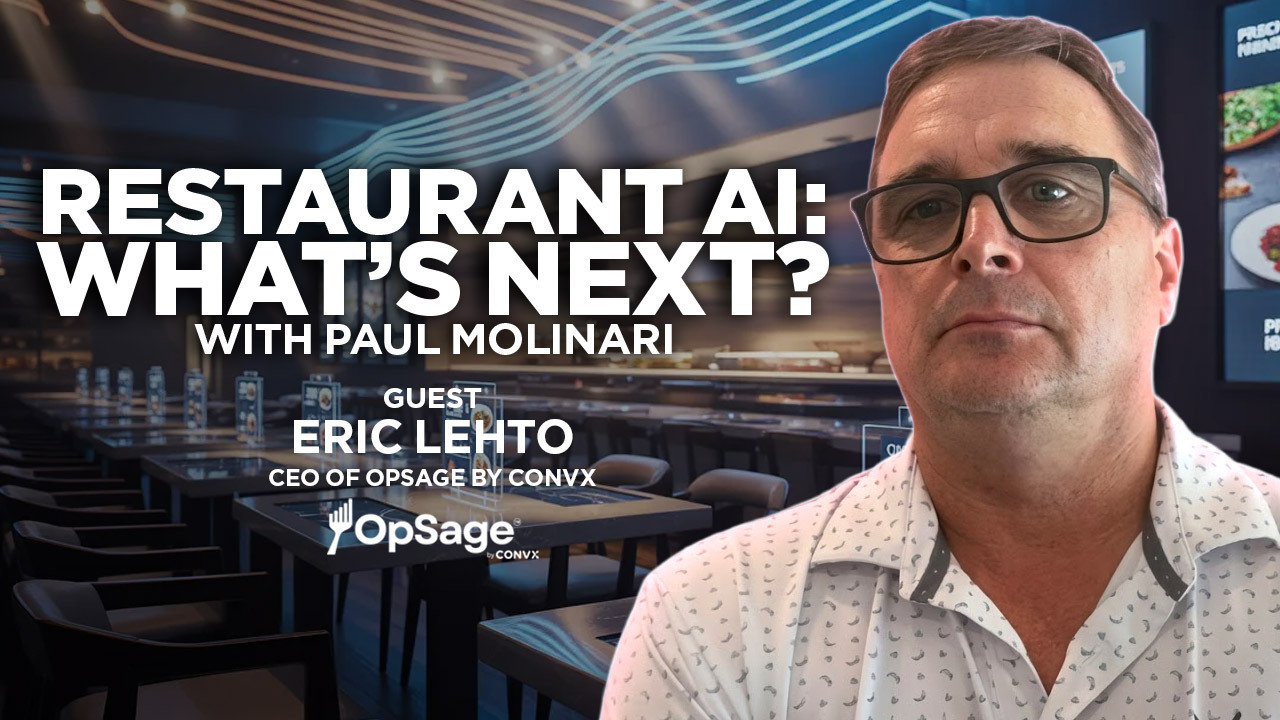
That question is exactly what the latest episode of *Modern Solutions for Modern Restaurants* digs into. Host Paul Molinari sat down with Eric Lehto, CEO of [OpSage by CONVX](https://opsage.com/), for a candid look at the state of restaurant AI data intelligence, what is working, what is not, and what operators need to understand before signing anything.
---
## The Data Problem Operators Are Not Talking About Publicly
Lehto opened with something most operators recognize but few discuss openly: the scale of the restaurant data problem is far larger than the industry acknowledges. He described a strategy workshop with a multi-unit operator that, by the time the session wrapped, had identified more than ten disconnected systems. Two POS platforms mid-migration. Inventory data that held information the POS never captured. Franchisee P&L reports arriving monthly as manual spreadsheets. Multiple loyalty, survey, and customer experience tools with no unified view.
The timeline to connect all of it? Months to reach initial KPIs. A year or more to hit the original goals. And by the time the build was complete, the business had already changed.
"It is unattainable for most restaurants because of the cost and the time," Lehto said. "Unless you're one of the largest chains, how can you possibly afford it on a restaurant budget?"
---
## Why Most AI Demos at the NRA Show Should Come With a Disclaimer
Walk the NRA Show floor and you will see AI positioned as a feature inside nearly every product category: scheduling, inventory, guest experience, POS. Most of it is general-purpose AI bolted onto existing software. Lehto had a phrase for that:
> "Your general AI is like a drunken genius. Really smart, but it just doesn't know your restaurant."
The core issue is context. A general AI model does not know your concept type, your menu structure, your regional cost benchmarks, or how your Omaha locations differ from your Chicago stores. Ask it which of your locations is underperforming on labor and it might reference an industry average that has nothing to do with your operation.
What closes that gap, Lehto explained, is not a smarter model. It is a semantic layer, built specifically for your organization, on top of [unified and cleaned data](https://opsage.com/convx-blog/data-cleaning-the-unsexy-superpower-behind-restaurant-savings). That layer translates what your operation actually means into the structure the AI needs to reason correctly. Without it, AI gives confident answers that are wrong for your business.
---
## The Security Question Every Operator Should Be Asking
At a show like the NRA, security rarely comes up in the AI conversation. It should be one of the first things on the table.
Lehto laid out a risk that most operators have not considered: traditional SaaS applications were built around predetermined queries. The software asks the database for exactly what it was programmed to ask. Security at the application layer works because nothing unpredictable gets through. Add AI to that architecture and the model starts generating queries dynamically. The application-layer security no longer holds. What the AI can ask, and therefore what data it can reach, becomes an open question.
The only architecture that holds up, he argued, is [security enforced at the data layer](https://opsage.com/convx-blog/your-restaurant-data-is-an-asset.-make-sure-youre-protecting-it) itself. Row-level permissions, sensitivity classes, and object-level controls that exist independent of whatever application or AI model sits on top of them. That architecture cannot be retrofitted. It has to be built in from the start.
The question every operator should ask any AI vendor at the next show: where does your security model live? Application layer or data layer?
---
## What the Operators Who Get This Right Already Have in Common
The episode closes on a practical note. Lehto described what the day-to-day experience looks like for operators who have the foundation right. The shift is not dramatic on the surface. It shows up Monday morning when a VP of Operations opens their inbox and the analysis is already done. Weather impact on last week's traffic. Labor variances by region. Prime cost movement at specific locations. Anomalies flagged before they compound. All of it written for their role, calibrated to their concept, requiring no queries or exports.
> "Customers are getting those benefits today," Lehto said. "There's no real barrier to it except being able to give it the right context and semantic layer so it understands your business."
His two-part advice for operators thinking about AI in the next few months: get started, and do it safely. Understand whether the AI you are evaluating is a consumer product that may train on your data, or an enterprise architecture that keeps your operational information private. And choose a partner that is genuinely a data expert, not a software company that added AI to its marketing materials between NRA Shows.
---
Would you like to learn more about OpSage? Request a free demonstration by filling out the form below.
### Request a Free Demonstration
---
*Modern Solutions for Modern Restaurants is a podcast focused on the technology, trends, and realities shaping the restaurant industry, hosted by Paul Molinari of* [*Popcorn GTM*](https://popcorngtm.com)*.*
## Share this post
[mailto:https%3A%2F%2Fopsage.com%2Fconvx-blog%2Fafter-the-nra-show-the-real-ai-question-for-restaurants-is-just-getting-started](mailto:https%3A%2F%2Fopsage.com%2Fconvx-blog%2Fafter-the-nra-show-the-real-ai-question-for-restaurants-is-just-getting-started)
## Keep reading
### [.jpg?width=1400&height=787&name=OpSage%20Daily%20(1).jpg) Release Notes Product The Busiest Night of Your Week Might Be on Someone Else's Calendar](https://opsage.com/convx-blog/local-events-restaurant-planning)
### [ Product Multi-Unit Restaurant Dashboards and Forecast Ranges](https://opsage.com/convx-blog/dashboards-and-forecasts-built-the-way-multi-unit-restaurants-run)
[](https://opsage.com/)
- [Restaurant Data Platform](https://opsage.com/restaurant-data-platform)
- [OpSage™ AI Assistant](https://opsage.com/opsage-ai-assistant)
- [Pro Services](https://convx.com)
- [About Us](https://opsage.com/about-convx)
- [Contact](https://opsage.com/contact)
- [Release Notes](https://opsage.com/release-notes)
- [FAQ](https://opsage.com/faq)
---
[Privacy Policy](https://opsage.com/privacy-policy) · Legal · © 2026 CONVX. All rights reserved.
```json
{
"@context" : "https://schema.org",
"@type" : "BlogPosting",
"author" : {
"@type" : "Person",
"name" : "Convx Team",
"url" : "https://opsage.com/convx-blog/author/conrad"
},
"dateModified" : "2026-06-01T14:13:28.967Z",
"datePublished" : "2026-06-01T14:13:09.000Z",
"headline" : "After the NRA Show, the Real AI Question for Restaurants Is Just Getting Started",
"image" : [ "https://opsage.com/hubfs/ai-next.jpg" ],
"mainEntityOfPage" : {
"@id" : "https://opsage.com/convx-blog/after-the-nra-show-the-real-ai-question-for-restaurants-is-just-getting-started",
"@type" : "WebPage"
},
"publisher" : {
"@type" : "Organization",
"logo" : {
"@type" : "ImageObject",
"url" : "https://opsage.com/hubfs/OpSage%20logo%20v1.2%20FInal.png"
},
"name" : "CONVX"
}
}
```